
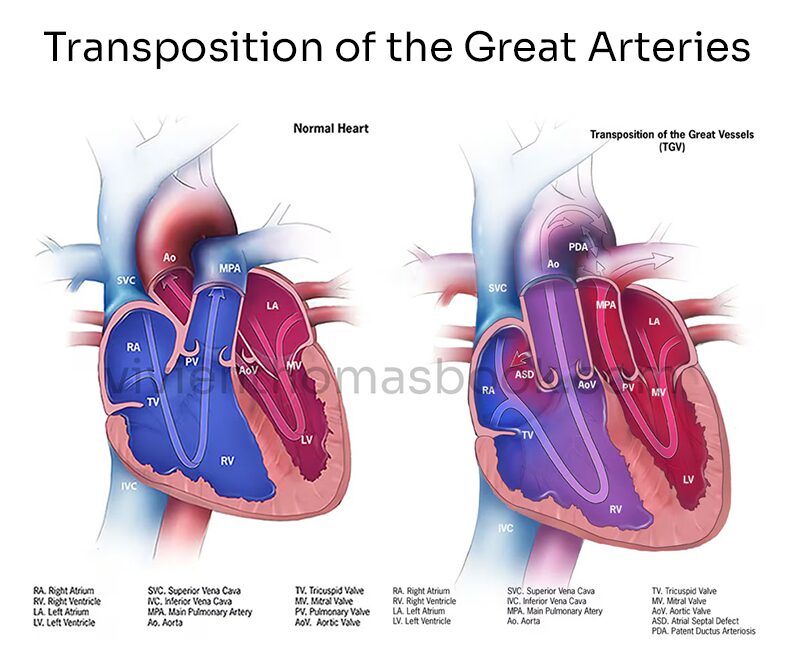
 Photo Credit: Centers for Disease Control and Prevention
Unfortunately, babies can be born with different heart problems. Another cardiac defect is called Transposition of the Great Arteries (TGA). This congenital malfunction occurs when two main arteries are misplaced or transposed, with the aorta connecting the right ventricle rather than the left ventricle, and with the pulmonary artery connecting to the left ventricle rather than the right, as this diagram demonstrates. Just like the TOF babies, the TGA babies also ended up with oxygen-poor blood in their blood circulation. Until Vivien Thomas found a way to ameliorate these problems, more than half of all TGA infants died in their first month and a frightening ninety percent of babies died within their first year.
After much experimentation and creative thinking, he devised the surgical steps to create a palliative measure that would not cure TGA babies but would keep them alive. By making an opening in their septum (an artificial atrial septal defect), the babies benefited from greater amounts of circulating oxygenated blood. Currently, the surgery is no longer performed but at the time, in combination with Thomas’s earlier TOF surgery, it helped shatter resistance for surgeries both on the heart and on babies. Thomas’s work significantly contributed to subsequent medical breakthroughs that quickly followed in these areas.
Thomas believed that this was the most meaningful surgery he’d ever created; it was the first surgery he devised without any helpful input from Dr. Blalock. When he demonstrated his artificially created atrial septal defect, it appeared so natural that Dr. Blalock exclaimed that it “looks like something the Lord made.”
In fact, Dr. Blalock gave full credit for the surgery to Mr. Thomas, writing in Thomas’s research notes that “This is an operation devised by Vivien ….” He asked Mr. Thomas to demonstrate his surgery to another doctor, Dr. C. Rollins Hanlon, who suggested an improvement that resulted in a smoother surface for suturing. Then Dr. Blalock asked Hanlon to take Mr. Thomas’s notes and write up the results for publication in 1948. To Vivien Thomas’s everlasting anguish, Blalock took the credit that Thomas deserved and gave it to Dr. Hanlon, naming Hanlon as the second author for the palliative septal defect surgery. Mr. Thomas was a Black man whose education went no farther than a high school diploma: he could safely be ignored. The medical world still calls this the Blalock-Hanlon operation.
© 2024 Writer's Cramp, Inc. All rights reserved.