
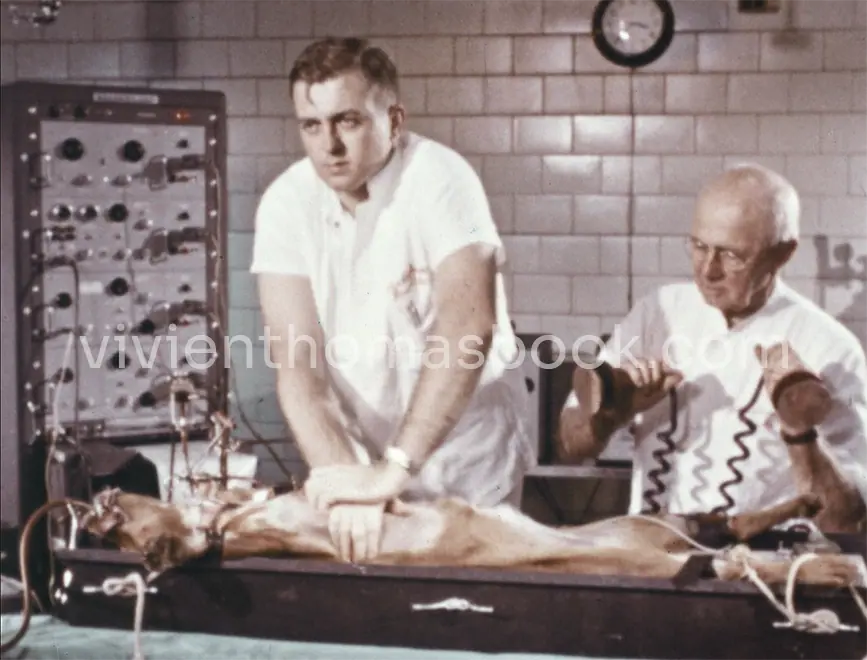
 Photo Credit: The Chesney Archives of Johns Hopkins Medicine, Nursing, and Public Health
At the end of the 1940s, medical researchers were exploring ways to save lives during cardiac arrest because there still wasn’t a standard way to restart the heart. Dr. Blalock put together a cardiac arrest investigatory team by assigning two people—a Hopkins fellow Dr. Jerome Kay and, of course, Mr. Vivien Thomas—to find a way to prevent death from occurring following a heart attack. Kay reached out to William Kouwenhoven, Ph.D., the Johns Hopkins University’s Dean of Electrical Engineering, who had been researching how to get a stopped heart to begin beating again.
Like Vivien Thomas, Kouwenhoven was both mechanically talented and an inveterate tinkerer. He had developed a crude device that he’d made from spare parts he’d found around the engineering department, and made a simple, yet effective, defibrillator that could restart a heart by giving it a shock of electric current. One day, Kay and Thomas were performing surgery on a dog when it went into cardiac arrest. Looking at each other, Kay and Thomas quickly improvised their response: Kay began massaging the dog’s heart while Thomas retrieved the defibrillator, attached it to the dog’s chest and shocked the dog with its electric current. This one-two approach of heart massage followed by defibrillation successfully restarted the dog’s heart. Kay and Thomas were the first to resuscitate a living creature from certain death in that manner but didn’t recognize its significance. Although Kay would write up several of the research projects he and Thomas worked on for publication, he did not publish their research on CPR and ventricular defribillation and so their work is overlooked.
A few years later, the remaining members of the Kouwenhoven cardiac arrest team—G. Guy Knickerbocker and James Jude—repeated these steps and assumed that they were the first. They widely publicized the life-saving technique to the public but as Dr. Kay later wrote Thomas, “Others received the credit, but it was Dr. Kouwenhoven, you and I who accomplished this. This was the beginning of closed heart massage and external defibrillation.”
The photo is from a 1961 medical training film, External Cardiac Massage, showing Knickerbocker applying CPR as Kouwenhoven stands to his right, ready to administer a shock from his electric defibrillator to a dog. In this and another CPR film, Vivien Thomas can be seen but is never identified.
© 2024 Writer's Cramp, Inc. All rights reserved.