
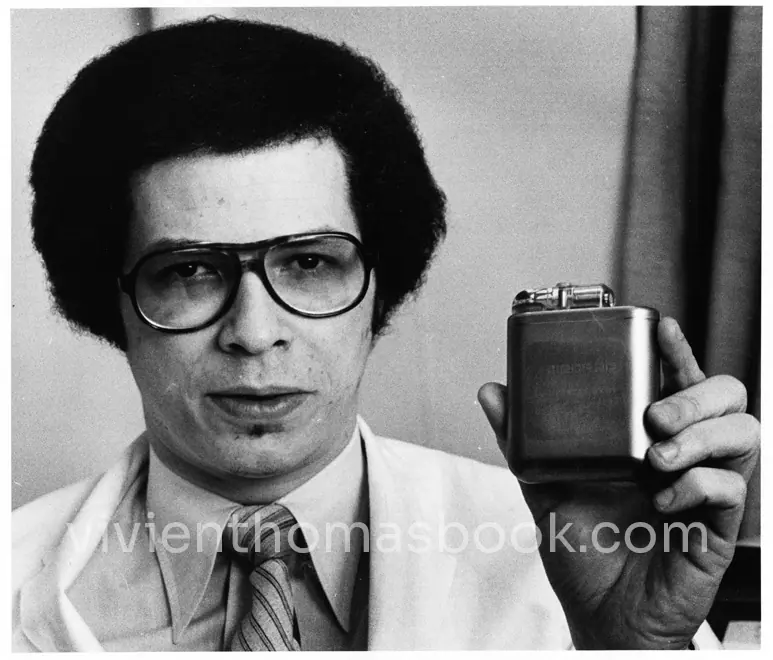
 Photo Credit: The Chesney Archives of Johns Hopkins Medicine, Nursing, and Public Health
In 1971, Dr. Levi Watkins arrived at Johns Hopkins to become a resident in surgery, the first Black man allowed to do so. He introduced himself to Vivien Thomas because he was curious after noticing Thomas’s portrait on display. The two men quickly became close friends. Both had lived in Nashville, and Watkins received his undergraduate degree from Tennessee State University where Thomas had planned to matriculate. Additionally, Watkins graduated from medical school at Vanderbilt University—the first Black person allowed to do so—where Thomas had worked for many years.
Thomas eagerly took the younger man under his wing. Thomas had seen how his own brother, Harold, had his teaching career derailed because of his NAACP-backed lawsuit for equal pay, and he did not want to see the same fate befall Watkins. Thomas would repeatedly urge Watkins to “watch his mouth” to navigate Hopkins’s campus that had been desegregated under federal law just a few years earlier. With the help of Thomas’s mentoring, Watkins successfully completed his residency and went to Harvard to continue his training. Upon returning to Hopkins in 1976, Watkins soon found himself in need of assistance doing research on dogs. To his delight, he found that Thomas was still working in the lab and teamed up with him. Watkins was part of a team working to design and test an implantable cardiovascular defibrillator (ICD).
At that time, you needed an external defibrillator nearby to survive a heart attack. People at medical schools throughout the country hoped to implant a personal defibrillator, the size of a cigarette pack, in a person with heart disease. It would automatically kick in to give a lifesaving shock. Watkins was working on an ICD which, placed in the body, could detect dysfunctional heartbeats, and would correct the abnormal heart rhythm. Before the device could be used in humans, it needed to be proven safe in lab dogs. Watkins and Thomas induced ventricular fibrillation in the lab dogs and then watched the ICD give the dogs the needed shock to restart their hearts.
Having achieved success with their dog experiments, Watkins was ready to implant the ICD in humans. Thomas had already retired by Feb 4,1980 when Watkins would successfully implant the first defibrillator in a person. ICDs have saved an estimated 650,000 lives in the U.S. alone. In this photo, Watkins is holding the device.
© 2024 Writer's Cramp, Inc. All rights reserved.